
This page defines the exact criteria required before any lay selection is published.
The Public Fade Rulebook removes emotion, prevents improvisation, and ensures every position follows a structured probability framework.
Public Fade Rulebook Summary
The Public Fade Rulebook is a structured lay betting framework designed to identify when market prices are distorted by public sentiment. It applies fixed entry criteria, controlled liability limits, liquidity confirmation, and probability analysis to maintain disciplined execution.
- Pre-match favourites under 4.0 odds only
- Narrative inflation required
- Price compression confirmed
- Liquidity verified
- Fixed 1-unit profit target
- No deviation from bankroll rules
The objective is not prediction. The objective is to identify structured probability mispricing.
What Is a Public Fade?
A public fade means laying a favourite whose price has been compressed by public sentiment rather than fundamental strength.
This typically occurs when:
- Media narratives inflate confidence
- Recreational bettors pile onto brand-name teams
- Recent short-term form distorts long-term probability
- Momentum headlines override tactical reality
The goal is not to predict chaos. The goal is to sell overpriced certainty.
Core Entry Criteria (All Must Be Met)

1. Favourite Priced Between 1.40 and 3.99 (Pre-Match Only)
I only lay favourites priced between 1.40 and 3.99 before kick-off.
This range is not random. It sits in the zone where public money most often compresses prices.
When a team is priced between 1.40 and 3.99, it is considered a winnable bet. Recreational bettors are naturally drawn to these teams because they look “safe.” Media narratives, recent winning streaks, and brand reputation often increase confidence beyond what the true probability supports.
That emotional backing can push odds slightly shorter than they should be. This is called price compression.
For example:
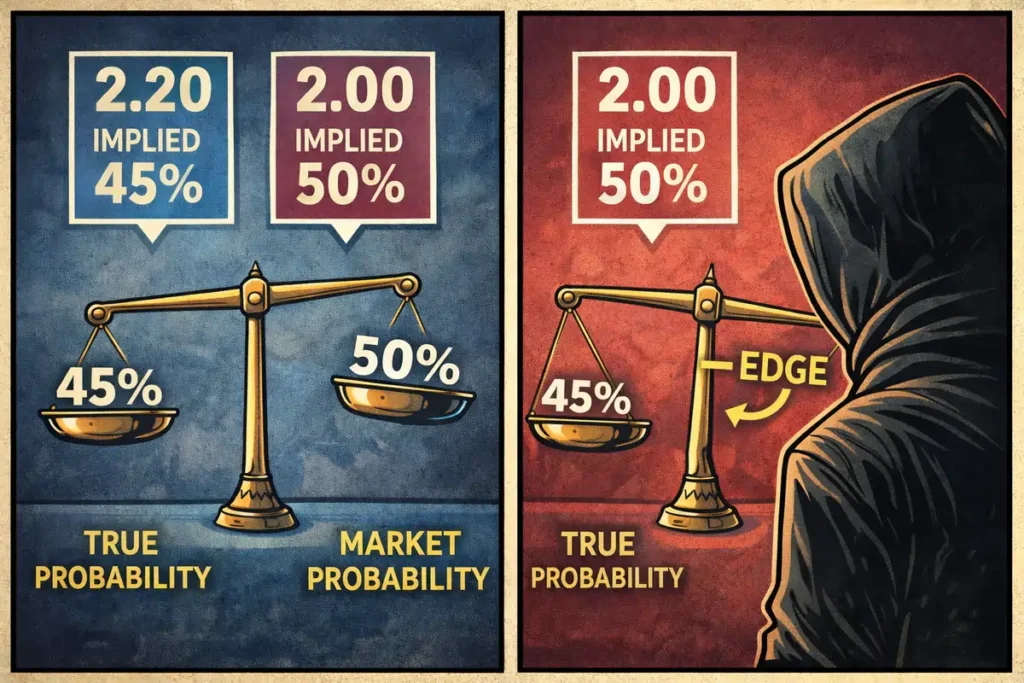
- A team priced fairly at 2.20 (45% implied probability) may shorten to 2.00 (50% implied probability) due to public demand.
- The market now overstates certainty by 5 percentage points.
This small distortion is where the edge exists.
Why under 4.0?
Once odds move above 4.0, liability increases significantly relative to potential profit. Laying at 5.0 means risking 4 units to win 1. That changes the strategy’s risk profile.
By staying below 4.0, I keep:
- Liability controlled
- Exposure structured
- Variance manageable
- Bank protection consistent
Why pre-match only?
In-play markets introduce delay, volatility, and rapid probability shifts that distort execution. Pre-match pricing reflects structured liquidity and stable sentiment conditions.
This rule ensures the strategy remains disciplined, repeatable, and aligned with controlled risk management..
2. Narrative Inflation
Narrative inflation occurs when public sentiment increases confidence in a team beyond what objective probability supports.
This usually happens after:
- A recent winning streak
- A dominant televised performance
- A high-profile signing or manager bounce
- Media hype or headline-driven momentum
- Public overreaction to a rival’s injuries
Recreational bettors are naturally influenced by stories. They back what feels convincing, not always what is priced correctly.
For example:
- A top club wins three matches comfortably.
- Headlines describe them as “unstoppable.”
- Public money floods into the favourite.
- The price shortens further.
But short-term form does not always change long-term probability.
Narrative inflation is not about fake information. It is about exaggerated certainty. The market shifts because confidence increases, not because true win probability has materially changed.
The edge comes from identifying when sentiment, not fundamentals, is driving price movement.
3. Price Compression Confirmed
Price compression happens when odds shorten due to demand rather than a genuine improvement in probability.
When heavy public money backs a favourite, the exchange adjusts prices lower to match that demand. This makes the favourite look safer than it objectively is.
Example:
- Opening odds: 2.20 (implied probability 45%)
- Heavy public backing enters the market
- Odds shorten to 2.00 (implied probability 50%)
The implied probability has increased by 5 percentage points.
The question is: did the team’s real chance of winning actually improve by 5%? Often, it did not.
This gap between true probability and implied probability is where structured lay value can exist.
Price compression alone is not enough. It must be paired with narrative inflation and liquidity confirmation.
How Odds Translate to Probability (Beginner Guide)
Decimal odds represent implied probability.
The formula is:
Implied Probability = 1 ÷ Decimal Odds
Examples:
- 1.50 odds → 66.7% implied probability
- 2.00 odds → 50% implied probability
- 2.50 odds → 40% implied probability
- 3.00 odds → 33.3% implied probability
When odds shorten, implied probability increases.
If public demand pushes odds from 2.20 to 2.00, the market is effectively saying the team’s chance increased from 45% to 50%.
The key question becomes: is that probability increase justified?
The Public Fade model looks for situations where implied probability increases faster than real probability.
4. Exchange Liquidity Verified
The lay must have sufficient matched volume and tight spreads.
No thin markets. No forced entries.
Disqualification Rules
A selection is rejected if:
- Odds exceed 4.0
- Liquidity is weak
- News materially shifts probability
- Multiple correlated risks stack exposure
- The setup relies on hope rather than structure
Not betting is part of the edge.
Liquidity & Market Confirmation
Every position requires:
- Verified matched volume
- Tight back/lay spreads
- Stable pricing pre-entry
High-liquidity leagues are prioritised.
Bankroll & Exposure Rules
The model operates on a 100-unit reference bank.
- No single lay exceeds 5% liability
- No progressive staking
- No recovery systems
- No deviation during variance
Discipline protects longevity.
Pre-Publication Checklist
Before any lay is posted, this checklist is completed:
- Favourite under 4.0?
- Narrative inflation present?
- Price compression confirmed?
- Liquidity sufficient?
- Bank exposure within limit?
- No conflicting structural risks?
If any answer is “No,” the position is not taken.
Why the Public Fade Betting Strategy Requires Discipline
The public fade betting strategy is not about blindly opposing favourites. It is about identifying when betting markets inflate probability due to sentiment rather than fundamentals.
By combining structured entry criteria, liquidity confirmation, and fixed liability management, the framework avoids emotional decision-making and focuses on repeatable probability edges.
Frequently Asked Questions
Is this strategy purely subjective?
No. While narrative recognition involves judgment, price band, liquidity, and exposure rules are fixed.
Do you ever break the 4.0 rule?
No. Structural integrity requires consistency.
Do you adjust staking during losing runs?
No. The staking model never changes.