
Intro
Welcome to a focused, single-play Thursday slate.
The public is locked onto first-leg expected goals and badge superiority, assuming statistical dominance in Athens will automatically translate into a comfortable win in Spain.
But knockout football is rarely that clean.
Tonight, we are stepping into the La Liga narrative and backing one of the oldest forces in European competition — disruption, frustration, and control of chaos.
Let’s step inside the Real Script.
Overview
Real Betis vs Panathinaikos presents a classic second-leg inefficiency where the market overvalues first-leg performance metrics while undervaluing game-state psychology. Teams protecting a lead often deploy extreme defensive tactics that disrupt rhythm and reduce scoring variance, making multi-goal victories far less likely than the market suggests.
The Slate
- Real Betis vs Panathinaikos (Europa League)
Real Betis vs Panathinaikos
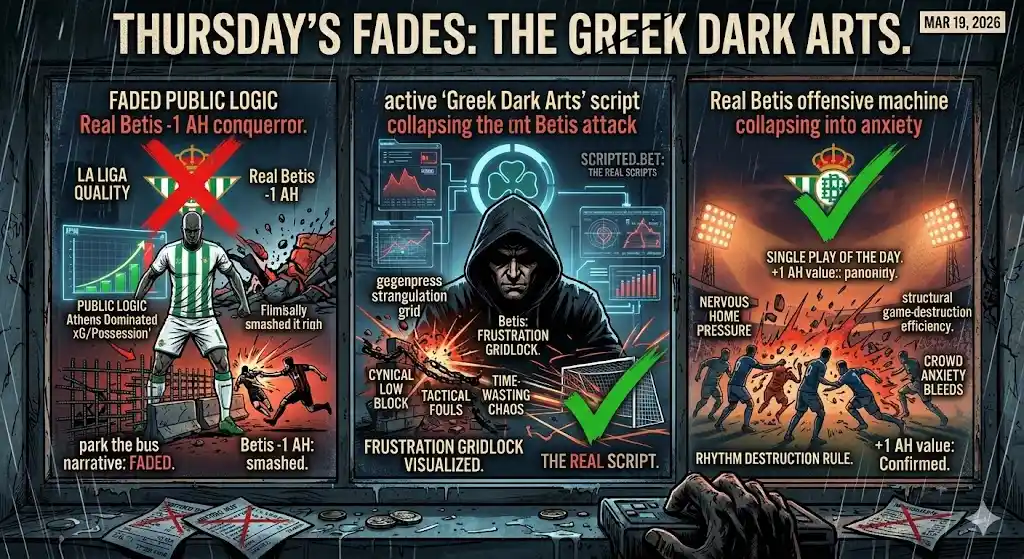
The Villain’s Move: Lay Real Betis -1 AH
Risk: 0.77 Units to win 1 Unit
The Public Logic
The public sees a misleading first-leg result.
Panathinaikos won 1-0 in Athens despite playing with ten men and conceding the majority of possession and chances.
Betis created the better opportunities and now return home to the Benito Villamarín, where La Liga quality and crowd pressure should, in theory, take over.
From a surface-level perspective, this looks like a straightforward bounce-back spot for the Spanish side.
The Real Script
The market is pricing this as a continuation of the first leg.
In reality, it is an entirely different game.
Chasing an aggregate deficit at home introduces a completely new psychological dynamic.
If Betis fail to score early, the energy inside the Benito Villamarín shifts quickly from expectation to anxiety.
That pressure bleeds onto the pitch — rushed decisions, forced passes, and structural imbalances begin to appear.
Panathinaikos understands this perfectly.
They are not coming to Spain to play open football.
They will deploy the full arsenal of European “dark arts”:
- relentless time-wasting
- tactical fouls to break transitions
- deep defensive blocks
- constant disruption of rhythm
Their objective is simple: turn the match into chaos, not football.
Even if Betis eventually breaks through and levels the tie, the game state still favors the underdog.
A 1-0 win — one of the most likely outcomes — results in a push on the handicap.
For Betis to cash the public narrative, they must win by multiple goals against a side specifically designed to prevent exactly that.
That is a far bigger ask than the market implies.
The handicap is not protection — it is a trap.
Why This Is a Classic Knockout Trap
Second-leg matches with narrow deficits often create inflated expectations for the favorite.
- Favorites are forced to chase early
- Underdogs control tempo through disruption
- Game flow becomes fragmented and unpredictable
These conditions rarely produce comfortable multi-goal victories.
Instead, they produce frustration, tension, and narrow scorelines.
Slate Summary
| Matchup | The Villain’s Move | Risk | Potential Win |
|---|---|---|---|
| Real Betis vs Panathinaikos | Lay Real Betis -1 AH | 0.77 Units | 1.00 Unit |
Final Totals
Total Risk: 0.77 Units
Total Potential Profit: 1.00 Unit
Closing Thought
The public sees dominance.
Sharp bettors see disruption.
And in European knockout football, disruption is often the stronger force.
Frequently Asked Questions
Why are second-leg Europa League matches difficult to predict?
Game state plays a major role. Teams protecting a lead often disrupt rhythm and slow the match, making outcomes less predictable.
Is a -1 handicap safe for favorites at home?
Not always. When facing defensive opponents using low blocks and time management, multi-goal wins become much harder to achieve.
What are “dark arts” in football?
Dark arts refer to tactical methods such as time-wasting, fouling, and slowing the game to disrupt opponents and control match tempo.


Leave a Comment